
How AI Learns Your Family's Food Preferences (The Expanding Circle Algorithm)
By ThisWeekEats Team
January 13, 2025
9 min read
How AI Learns Your Family's Food Preferences (The Expanding Circle Algorithm)
The Family Dinner Dilemma:
- Dad loves salmon. Mom hates all fish.
- Your 8-year-old will only eat chicken nuggets and pasta.
- Your teenager is suddenly vegetarian.
- You're trying to eat healthier, but everyone else wants comfort food.
The question: How do you plan meals that satisfy everyone without making three different dinners every night?
The traditional answer: You can't. Someone compromises. Usually, that someone is you.
The AI answer: The Expanding Circle Algorithm.
The Problem: Conflicting Preferences Are the Norm, Not the Exception
Most meal planning systems are designed for individuals or assume families have uniform tastes. Reality is messier.
Real Families Have Real Conflicts:
- Protein preferences: One person loves beef, another avoids red meat
- Vegetable battles: Brussels sprouts are divisive (love them or hate them)
- Cuisine preferences: Mexican food enthusiast vs. plain-food-only eater
- Cooking methods: Health-conscious person avoids fried food; picky eater prefers it
- Allergen restrictions: One person's allergy eliminates entire food categories
- Dietary phases: Keto dad, plant-based teenager, growing kid who needs carbs
Traditional meal planning forces you to either:
- Cook to the lowest common denominator (boring, safe meals nobody dislikes but nobody loves)
- Rotate who gets their preference (Tuesday is Dad's night, Wednesday is Mom's night—nobody's happy)
- Make multiple meals (exhausting and time-consuming)
There has to be a better way.
Introducing the Expanding Circle Algorithm
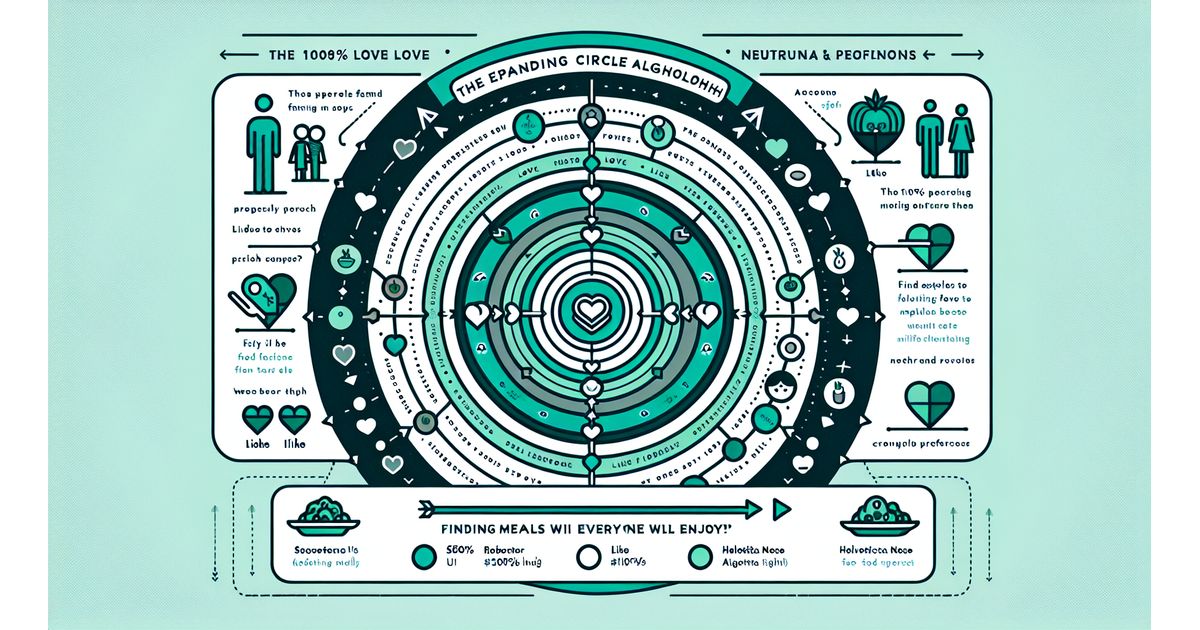
The Expanding Circle Algorithm is a progressive preference selection system that intelligently balances conflicting tastes. Instead of compromise, it finds optimal overlap—meals that maximize satisfaction across the family.
Here's how it works:
The Core Concept: Start Small, Expand as Needed
Imagine your family's food preferences as concentric circles:
Circle 1 (Center): Unanimous Favorites
- Foods everyone loves with zero dislikes
- Highest priority
- These form the core of your meal plans
Circle 2: Broad Appeal
- Foods most people love or like, even if some are neutral
- High priority
- Used when Circle 1 runs out
Circle 3: Acceptable Options
- Foods that are liked or neutral, with minimal dislikes
- Moderate priority
- Expands variety without major objections
Circle 4: Last Resort
- Foods that meet minimum requirements (someone doesn't hate it)
- Rarely used
- Only if needed to meet recipe targets
The algorithm starts at the center (unanimous favorites) and expands outward only when necessary. This ensures your meal plans prioritize what your family actually loves, not just what's tolerable.
How It Works: The Four-Pass System
When you request a meal plan, the AI runs through four passes to select proteins for your meals:
Pass 1: Unanimous Love (Circle 1)
Goal: Find proteins everyone loves.
Criteria:
- At least one family member rates it "Love"
- Zero family members rate it "Avoid" or "Never"
Examples:
- Dad loves chicken → Include
- Everyone's neutral on pork → Skip (no "Love" rating)
- Mom avoids beef → Skip (has "Avoid" rating)
Why this matters: Pass 1 ensures that your meal plans start with proteins that at least one family member is excited about, and nobody dislikes. This maximizes meal satisfaction.
Pass 2: Love + Like Wins (Circle 2)
Goal: Expand to proteins that are broadly appealing.
Criteria:
- Combined "Love" + "Like" ratings outnumber "Avoid" ratings
- Example: 2 people love it, 1 person likes it, 1 person avoids it → Include (3 positive vs. 1 negative)
Examples:
- Salmon: Dad loves, kids are neutral, Mom avoids → Skip (1 love + 0 likes vs. 1 avoid = doesn't qualify)
- Ground turkey: Mom loves, Dad likes, kids are neutral → Include (1 love + 1 like = broad appeal)
Why this matters: Pass 2 finds proteins where the majority of the family has positive feelings, even if one person is neutral or mildly avoids it. This balances preferences democratically.
Pass 3: Include Neutral (Circle 3)
Goal: Add acceptable proteins that expand variety without strong objections.
Criteria:
- Combined "Love" + "Like" + "Neutral" ratings outnumber "Avoid"
- Example: 1 love, 1 like, 1 neutral, 1 avoid → Include (3 positive/neutral vs. 1 avoid)
Examples:
- Tofu: Teenager loves, Mom is neutral, Dad and kid are neutral → Include (1 love + 3 neutral = no strong objection)
- Lamb: Dad loves, everyone else is neutral → Include (1 love + 3 neutral = acceptable variety)
Why this matters: Pass 3 introduces variety by including foods that nobody's excited about but nobody hates. It prevents meal plans from becoming too narrow.
Pass 4: Last Resort (Circle 4)
Goal: Use only if necessary to meet recipe pool targets.
Criteria:
- Any protein not marked "Never" by anyone
- Used rarely and only when earlier passes don't provide enough options
Examples:
- Shrimp: Dad loves, Mom marked "Never" → Skip (absolute exclusion)
- Tilapia: Everyone is neutral or avoids slightly → Include only if needed for variety
Why this matters: Pass 4 ensures you have enough recipe variety, but it's used sparingly. Most families never reach this pass because Passes 1-3 provide ample options.
The "Love Wins" Philosophy
One of the most important design principles of the Expanding Circle Algorithm is this:
If someone loves it, include it—even if others are neutral or mildly avoid it.
Why This Matters
Traditional meal planning often defaults to the lowest common denominator:
- "Nobody loves this, but nobody hates it either, so it's safe."
The result? Boring, unmemorable meals.
The Expanding Circle flips this:
- "Someone loves this, and nobody's strongly opposed, so let's include it."
The result? Meals that make at least one person excited, which elevates the whole family's dining experience.
Real-World Example:
Family:
- Dad: Loves salmon (rates it "Love")
- Mom: Neutral on salmon (rates it "Neutral")
- Kid 1: Dislikes salmon (rates it "Avoid")
- Kid 2: Neutral on salmon (rates it "Neutral")
Traditional approach: Skip salmon (one person dislikes it).
Expanding Circle approach:
- Pass 1: Skip (1 love, but 1 avoid = doesn't qualify)
- Pass 2: Skip (1 love vs. 1 avoid = tied)
- Pass 3: Include (1 love + 2 neutral vs. 1 avoid = 3 vs. 1, qualifies)
Result: Salmon appears occasionally (not every week), giving Dad a meal he loves while not over-exposing the family to a divisive protein.
The balance: Dad gets his favorite sometimes. The kid who dislikes it tolerates it occasionally (because it's not frequent). Everyone wins.
Base Protein Aggregation: Simplicity Without Sacrifice
One challenge with meal planning is that many proteins have cooking variants:
- Chicken (Grilled)
- Chicken (Fried)
- Chicken (Baked)
- Chicken (Stir-Fried)
If you rate each variant separately, preference management becomes overwhelming (169+ food ingredients × multiple cooking methods = chaos).
Solution: The algorithm uses base protein aggregation.
How It Works:
- You rate the base protein (e.g., "Chicken") with a single rating (Love, Like, Neutral, Avoid, Never).
- The AI applies that rating to all cooking methods (grilled, baked, fried, etc.).
- You can override specific cooking methods if needed (e.g., "I love chicken but never want it fried for health reasons").
Example:
- You rate "Chicken" as "Love"
- The AI generates meals with grilled chicken, baked chicken, chicken stir-fry, etc.
- You rate "Chicken (Fried)" as "Never"
- The AI stops generating fried chicken specifically, but continues with other methods.
Why this matters: You get simplicity (one rating covers all methods) with flexibility (you can fine-tune when needed).
Cooking Method Intelligence
Related to base protein aggregation is cooking method intelligence—the AI's ability to respect critical restrictions while allowing creative flexibility.
The Problem:
You love chicken, but you're trying to eat healthier and avoid fried food entirely.
Traditional systems:
- Either avoid chicken entirely (too restrictive)
- Or allow all chicken methods (ignores your health goal)
Expanding Circle solution:
- Rate "Chicken" as "Love"
- Rate "Chicken (Fried)" as "Never"
- The AI generates grilled, baked, stir-fried, and poached chicken—but never fried.
Why this matters: You get the flexibility of AI creativity (it can try grilling, baking, sautéing) while respecting your hard boundaries (no frying).
Another Example: Adventurousness
Family adventure setting: Conservative
- You love shrimp but don't want exotic preparations
- The AI generates shrimp scampi, grilled shrimp, shrimp tacos (familiar American cuisines)
- It avoids shrimp curry, shrimp pho, or Szechuan shrimp (too adventurous for your setting)
Family adventure setting: Adventurous
- Same shrimp rating
- The AI now includes Thai shrimp curry, Vietnamese spring rolls, Japanese tempura
- You get the same ingredient, but with more culinary variety
The algorithm adapts creativity to your comfort level.
Real-World Scenarios: How Families Benefit
Scenario 1: The Picky Eater Family
Family:
- Dad: Eats anything
- Mom: Avoids red meat
- Kid 1 (age 6): Only loves chicken nuggets, pasta, pizza
- Kid 2 (age 10): Vegetarian phase
Traditional meal planning:
- Defaults to pasta, cheese pizza, and chicken (boring and nutritionally limited)
Expanding Circle approach:
- Pass 1 (Unanimous Love): Chicken (Kid 1 loves it, nobody avoids it)
- Pass 2 (Love + Like Wins): Ground turkey (Dad and Mom like it, kids are neutral), tofu (Kid 2 loves it, others neutral)
- Pass 3 (Include Neutral): Eggs, beans, lentils (vegetarian-friendly, nobody objects)
Result: Meal plans include chicken (Kid 1's favorite), plant-based proteins (Kid 2's preference), and variety (turkey, eggs, beans) without red meat (Mom's restriction). Everyone gets their needs met, and meals are more interesting.
Scenario 2: The "One Person Ruins It" Problem
Family:
- 3 people love seafood
- 1 person hates all fish
Traditional meal planning:
- Skip seafood entirely (one person's dislike overrides everyone else's preference)
Expanding Circle approach:
- Pass 1: Skip seafood (1 person avoids it)
- Pass 2: Skip seafood (doesn't meet "Love + Like > Avoid" threshold)
- Pass 3: Include seafood occasionally (3 loves vs. 1 avoid = qualifies)
Result: Seafood appears 1-2 times per month (not weekly). The majority gets their favorite, and the dissenter tolerates it occasionally. The frequency is low enough that it doesn't feel oppressive.
Alternative: The dissenter can be marked as "not home for dinner" on seafood nights, or the system schedules seafood on nights when they're eating elsewhere.
Scenario 3: The Health-Conscious vs. Kid-Friendly Battle
Family:
- Parents: Trying to eat healthier, love vegetables, prefer grilled/baked
- Kids: Prefer fried foods, avoid most vegetables
Traditional meal planning:
- Either cook "kid food" (parents eat unhealthily)
- Or cook "adult food" (kids refuse to eat)
Expanding Circle approach:
- Base protein: Chicken (everyone loves it)
- Cooking methods:
- Parents rate "Chicken (Fried)" as "Avoid"
- Kids rate "Chicken (Grilled)" as "Neutral"
- Pass 2: Include grilled/baked chicken (2 loves + 2 neutral = broad appeal)
- Frequency control: Fried chicken appears rarely (only in Pass 3/4 if needed)
Result: Mostly grilled/baked chicken (healthier for parents), occasional fried chicken (keeps kids happy), and everyone eats the same meal.
The Feedback Loop: It Gets Smarter Over Time
The Expanding Circle Algorithm isn't static—it learns from your ratings.
How It Works:
-
You make a meal (e.g., Grilled Lemon Herb Chicken)
-
Each family member rates it (Love, Like, OK, Avoid, Never)
-
The system updates preferences:
- If multiple people "Love" it → Schedule more frequently
- If someone marks "Never" → Remove from that person's future meals
- If ratings are mixed → Adjust frequency (appear occasionally, not weekly)
-
Future meal plans reflect these ratings:
- Favorites appear more often
- Disliked meals are skipped
- The system fine-tunes to your actual tastes (not what you thought you'd like)
Real-World Example:
Week 1: The AI generates "Thai Basil Chicken" based on your "Adventurous" setting and "Love chicken" preference.
After eating it:
- Dad: "Love it!" (rates it 5/5)
- Mom: "Too spicy" (rates it 2/5 - Avoid)
- Kids: "It's okay" (rate it 3/5 - Neutral)
Week 3: The AI schedules Thai Basil Chicken again (Dad loved it, others tolerated it).
Week 5: You rate it again:
- Dad: Still loves it
- Mom: Still avoids it
- Kids: "Never again" (rate it 1/5)
Weeks 7+: The AI stops scheduling Thai Basil Chicken (two "Never" ratings = removed from rotation).
The system learned: What seemed like a good fit initially was actually divisive. Ratings corrected the course.
Why This Matters: The Psychology of Meal Satisfaction
Traditional meal planning assumes that tolerance = satisfaction.
The truth: A meal where everyone is "fine" with it is forgettable. A meal where someone is excited about it elevates the experience for everyone.
The Expanding Circle Algorithm optimizes for positive excitement, not just absence of complaints.
The Result:
- Someone looks forward to dinner (because it's their favorite)
- Others are satisfied (because it's not something they dislike)
- Variety increases (because the algorithm rotates through everyone's favorites)
- Meal satisfaction improves (because meals feel personalized, not generic)
Family dinners become something to enjoy, not endure.
Technical Brilliance, Human Results
The Expanding Circle Algorithm sounds complex—and it is, under the hood. But for you, the user, it's invisible.
You just:
- Rate foods once (Love, Like, Neutral, Avoid, Never)
- Request a meal plan
- Get meals that feel perfectly tailored to your family
The algorithm handles:
- Progressive expansion (start with favorites, expand as needed)
- Democratic balancing (Love wins, but majorities matter)
- Cooking method intelligence (respect hard boundaries, allow creativity)
- Base protein aggregation (simplicity with flexibility)
- Learning over time (ratings improve future plans)
The result: Meal planning that feels like it was designed by someone who knows your family intimately—because, in a way, it was.
Ready to See It in Action?
Try ThisWeekEats free for 7 days. Set up your family preferences, generate your first meal plan, and watch the Expanding Circle Algorithm find meals that satisfy everyone—without compromise.
Medical Disclaimer
This article provides general information about meal planning and food preferences. Individual nutritional needs vary based on age, health conditions, activity level, and other factors. Always consult with a registered dietitian, physician, or other qualified healthcare professional for personalized dietary guidance, especially if you have existing health conditions, food allergies, or specific dietary requirements.
Ready to Experience AI Meal Planning?
Try ThisWeekEats free for 7 days. No credit card required.
Start Your Free Trial