
From Preferences to Plate: How AI Meal Planning Actually Works
By ThisWeekEats Team
January 10, 2025
9 min read
From Preferences to Plate: How AI Meal Planning Actually Works
You might think AI meal planning is simple:
- You ask ChatGPT for a recipe
- It gives you one
- Done
Reality is far more complex.
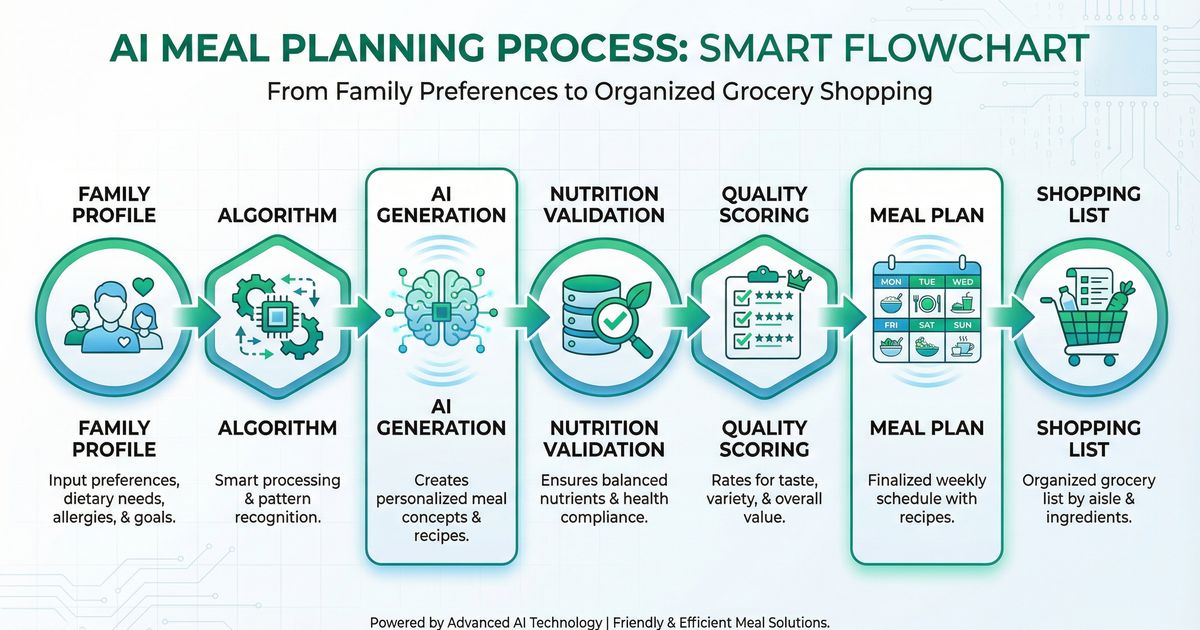
Generating a single meal plan for a family with diverse preferences, dietary restrictions, nutritional needs, budget constraints, and safety requirements involves:
- Preference algorithms (Expanding Circle selection)
- AI recipe generation (Hugging Face + Spoonacular backup)
- Nutrition lookup systems (local DB, cache, USDA API, AI fallback)
- Quality validation (4-tier recipe grading)
- Allergen safety checks (5-layer protection)
- Learning systems (feedback loops)
This article pulls back the curtain on how it all works—from your family profile to the recipes that land on your plate.
Step 1: Building Your Family Profile (The Foundation)
Before the AI can generate personalized meal plans, it needs to understand your family.
What You Provide:
Family Members:
- Names
- Ages (affects calorie targets)
- Weekly eating schedule (who's home for which meals)
Food Preferences (169+ ingredients across 7 categories):
- Rating scale: Love, Like, Neutral, Avoid, Never
- Categories: Proteins, vegetables, grains, fruits, dairy, pantry staples, general ingredients
Dietary Restrictions:
- Vegetarian, vegan, gluten-free, dairy-free, keto, paleo, low-carb, etc.
Allergens (5-layer safety system):
- Critical exclusions with derivative detection
Cuisine Preferences:
- Main cuisines: American, Italian, Mexican, Asian
- Accordion cuisines (24 options): Thai, Indian, Vietnamese, Japanese, Korean, Greek, French, etc.
- Adventure level: Conservative, Moderate, Adventurous
Family Settings:
- Budget: Budget-conscious ($5-8/meal), Moderate ($8-12), Flexible ($12+)
- Cooking skill: Beginner, Intermediate, Advanced
- Health focus: Balanced, Low-carb, High-protein, Heart-healthy
- Recipe pool sizes: Breakfast (3-15), Lunch (5-25), Dinner (15-60)
This data becomes the input for the algorithm.
Step 2: The Expanding Circle Algorithm (Protein Selection)
When you request a meal plan, the first step is selecting which proteins to use throughout the week.
How It Works (4-Pass System):
Pass 1: Unanimous Love
- Include proteins where at least one person loves it, and zero people avoid it
- Example: Chicken (Dad loves, everyone else likes/neutral) → Include
Pass 2: Love + Like Wins
- Include proteins where combined Love + Like ratings outnumber Avoid
- Example: Ground turkey (2 love, 1 like, 1 neutral) → Include
Pass 3: Include Neutral
- Include proteins where Love + Like + Neutral outnumber Avoid
- Example: Tofu (1 love, 3 neutral) → Include
Pass 4: Last Resort
- Use only if needed to meet recipe pool targets
- Rarely reached for most families
Result: A prioritized list of proteins for the week (e.g., chicken, salmon, beef, tofu, eggs, turkey, beans).
The algorithm ensures:
- Favorites come first
- Variety is maintained (no chicken every night)
- Protein frequency limits are respected (configurable: max 2x/week per protein)
Step 3: AI Recipe Generation (The Creative Engine)
Once proteins are selected, the AI generates recipes.
The AI System (Hugging Face + Spoonacular Backup):
Primary: Hugging Face Llama 3.3 (70B parameters)
- Open-source large language model
- Trained on millions of recipes
- Generates custom recipes tailored to your family
Backup: Spoonacular API
- Recipe database with 380,000+ recipes
- Used if Hugging Face is unavailable
- Filtered by your preferences and restrictions
What the AI Receives:
Input Prompt:
"Generate a dinner recipe for a family of 4 with the following requirements:
- Protein: Chicken (grilled or baked, no fried)
- Cuisine: Italian, American
- Budget: $8-12 per person
- Cooking skill: Intermediate
- Health focus: Balanced macros (carbs 45-65%, fat 20-35%, protein 10-30%)
- Allergen alerts: CRITICAL - avoid peanuts, peanut butter, peanut oil, satay sauce
- Dietary restrictions: None
- Preferences: Include vegetables family loves (broccoli, bell peppers, zucchini), avoid cilantro
- Calorie target: ~500-600 calories per serving (35% of daily 1,800 calories for moderate activity female)
Include:
- Recipe title
- Ingredient list with exact amounts (structured format: amount as number, unit, ingredient name)
- Step-by-step instructions
- Prep time and cook time
- Estimated nutrition (calories, protein, carbs, fat per serving)"
AI Output:
Recipe: Lemon Herb Grilled Chicken with Roasted Bell Peppers and Garlic Parmesan Broccoli

Ingredients:
- 4 boneless skinless chicken breasts (6 oz each)
- 2 tablespoons olive oil
- 1 lemon (juiced)
- 2 teaspoons dried oregano
- 2 teaspoons garlic powder
- 1 teaspoon salt
- 0.5 teaspoon black pepper
- 2 red bell peppers (sliced)
- 2 yellow bell peppers (sliced)
- 4 cups broccoli florets
- 3 cloves garlic (minced)
- 0.25 cup parmesan cheese (grated)

Instructions:
1. Preheat grill to medium-high heat (400°F).
2. In a small bowl, whisk together olive oil, lemon juice, oregano, garlic powder, salt, and pepper.
3. Brush chicken breasts with marinade and let sit for 10 minutes.
4. Grill chicken for 6-7 minutes per side until internal temperature reaches 165°F. Let rest for 5 minutes.
5. While chicken cooks, toss sliced bell peppers with 1 tablespoon olive oil and roast at 425°F for 15 minutes.
6. Steam broccoli for 5-6 minutes until tender. Toss with minced garlic and parmesan.
7. Serve chicken with roasted peppers and garlic parmesan broccoli.

Prep Time: 15 minutes
Cook Time: 20 minutes
Total Time: 35 minutes

Nutrition (per serving):
- Calories: 520
- Protein: 48g
- Carbs: 18g
- Fat: 28g
The AI balances:
- Your preferences (loved vegetables, avoided ingredients)
- Nutritional targets (balanced macros, calorie range)
- Cooking constraints (skill level, time)
- Budget (ingredients within price range)
Step 4: Hybrid Nutrition Lookup System (Accuracy Matters)
AI-generated nutrition estimates can be inaccurate (hallucinated values). To ensure precision, the system uses a hybrid nutrition lookup:
4-Tier Lookup System:
1. Local Database (Instant)
- 200+ common ingredients manually verified
- Examples: chicken breast, broccoli, olive oil, rice, eggs
- Speed: Instant (0ms)
- Accuracy: ★★★★★ (verified data)
2. Nutrition Cache (Instant)
- Previously looked-up ingredients cached forever
- Examples: Less common items looked up once (quinoa, tahini, coconut milk)
- Speed: Instant (0ms)
- Accuracy: ★★★★★ (USDA-verified, cached)
3. USDA FoodData Central API (500-700ms)
- Official U.S. government nutrition database
- 400,000+ foods with verified nutrition data
- Used for exotic or uncommon ingredients
- Speed: 500-700ms per ingredient
- Accuracy: ★★★★★ (government-verified)
4. AI Fallback (2-5 seconds)
- Hugging Face Llama 3.3 estimates nutrition when USDA doesn't have data
- Used for very rare ingredients (exotic spices, regional foods)
- Speed: 2-5 seconds per ingredient
- Accuracy: ★★★☆☆ (AI estimate, less reliable)
Process Flow:
- Check local database → Found? Use it.
- Check cache → Found? Use it.
- Query USDA API → Found? Cache it and use it.
- AI estimate → Use as last resort.
Result: Fast, accurate nutrition data for 95%+ of ingredients. AI estimates are rare and flagged for review.
Step 5: Recipe Quality Assessment (4-Tier Grading System)
Not all AI-generated recipes are created equal. Some are excellent. Some are... not.
The system automatically grades every recipe using four criteria:
1. Calorie Appropriateness (30% weight)
Target calorie ranges by meal type:
- Breakfast: 300-500 calories
- Lunch: 400-600 calories
- Dinner: 500-700 calories
Grading:
- Excellent: Within target range
- Good: Within 10% of range
- Poor: More than 20% off target
Why this matters: Meals that are too high or too low in calories disrupt balanced eating.
2. Nutritional Balance (25% weight)
Target macronutrient ranges (Harvard, Mayo Clinic, NIH guidelines):
- Carbs: 45-65% of calories
- Fat: 20-35% of calories
- Protein: 10-30% of calories
Grading:
- Excellent: All macros within range
- Good: 2 of 3 within range
- Poor: Only 1 or fewer within range
Why this matters: Extreme macros (keto, very low-fat) aren't sustainable for most families long-term.
3. Protein Frequency Compliance (25% weight)
Configured limits:
- Example: Chicken max 2-3x/week, beef max 1-2x/week, fish min 1x/week
Grading:
- Excellent: All proteins within frequency limits
- Good: 1 protein slightly over limit
- Poor: Multiple proteins over limits (e.g., chicken 4x/week)
Why this matters: Variety prevents nutritional monotony and flavor fatigue.
4. Nutrition Data Completeness (20% weight)
Checks:
- Are all ingredients accounted for?
- Is nutrition data available for all ingredients?
- Are there missing macros (protein, carbs, fat)?
Grading:
- Excellent: 100% complete data
- Good: 90-99% complete (1-2 minor ingredients missing)
- Poor: Less than 90% complete
Why this matters: Incomplete data means inaccurate calorie/macro tracking.
Overall Recipe Score:
Formula:
Score = (Calorie Appropriateness × 30%) + (Nutritional Balance × 25%) +
        (Protein Frequency × 25%) + (Data Completeness × 20%)
Grading scale:
- 80-100: Excellent (keep, schedule frequently)
- 60-79: Needs improvement (keep, but flag for review)
- 0-59: Poor (regenerate or remove)
Result: Only high-quality recipes make it to your meal plan.
Step 6: The Feedback Loop (Learning System)
The system isn't static—it learns from your ratings.
How It Works:
After you make a meal:
- Each family member rates it (Love, Like, OK, Avoid, Never)
- Ratings are stored and linked to the recipe
Future meal plans adjust:
- Love ratings: Recipe scheduled more frequently (appears every 2-3 weeks)
- Like ratings: Recipe stays in rotation (appears every 4-6 weeks)
- OK ratings: Recipe used occasionally (appears every 2-3 months)
- Avoid ratings: Recipe frequency reduced significantly (appears every 6+ months)
- Never ratings: Recipe removed from rotation for that person (or entirely if multiple "Never" ratings)
Example:
- Week 1: AI generates "Thai Basil Chicken"
- Week 2: You rate it "Love" (Dad), "OK" (Mom), "Avoid" (Kid 1), "Never" (Kid 2)
- Week 4: AI schedules it again (Dad loved it, others tolerated it)
- Week 6: You rate it "Never" (Kid 1 changed from Avoid to Never)
- Week 8+: AI removes "Thai Basil Chicken" entirely (two "Never" ratings = too divisive)
The system learns what your family actually enjoys, not just what it thought you'd like.
Step 7: Meal Plan Assembly (Putting It All Together)
Once proteins are selected, recipes are generated, and quality is validated, the system assembles your week:
Meal Plan Structure:
- 7 days × 3 meals (breakfast, lunch, dinner) = 21 meals/week
- Adjusted for your family's schedule (e.g., skip lunch if kids eat at school)
Balance checks:
- Protein variety (no repeats within 3-4 days)
- Cuisine rotation (Italian Monday, Mexican Wednesday, Asian Friday)
- Calorie distribution (25% breakfast, 30% lunch, 35% dinner, 10% snacks)
- Vegetable variety (different colors/types each day)
Leftover planning:
- Configurable: Cook extra portions for next-day lunches
- Smart scheduling: If you cook Monday dinner for 6 servings, Tuesday lunch is marked as "leftover"
Result: A complete, balanced, personalized meal plan—ready to execute.
Step 8: Shopping List Generation (One-Click Convenience)
Once your meal plan is finalized, generating a shopping list is instant:
Process:
- Extract all ingredients from the week's recipes
- Consolidate duplicates (3 recipes need onions → combine into "3 onions")
- Organize by grocery store section (produce, dairy, meat, pantry, frozen)
- Flag items you might already have (pantry staples like olive oil, salt, spices)
Output:
Produce:
- 3 onions
- 2 bell peppers (red)
- 2 bell peppers (yellow)
- 4 cups broccoli florets
- 1 lemon
- 3 cloves garlic

Meat & Seafood:
- 4 boneless skinless chicken breasts (6 oz each)
- 2 salmon fillets (6 oz each)
- 1 lb ground beef (90% lean)

Dairy:
- 0.25 cup parmesan cheese (grated)
- 1 cup milk (2%)

Pantry:
- Olive oil (if low)
- Dried oregano (if low)
- Garlic powder (if low)
You shop once. Cook all week. No forgotten ingredients. No extra trips.
Why This Isn't "Just ChatGPT"
You might think: "Can't I just ask ChatGPT for recipes?"
Yes, but you'd be missing:
- Preference algorithms (Expanding Circle, protein rotation)
- Allergen safety (5-layer protection with derivative detection)
- Nutrition accuracy (hybrid lookup system, not AI estimates)
- Quality scoring (4-tier grading, automatic filtering)
- Learning loops (ratings improve future plans)
- Family-wide coordination (scheduling, portion scaling, leftover planning)
- Shopping list automation (categorized, consolidated)
ChatGPT gives you a recipe. ThisWeekEats gives you a system.
The Bottom Line: Intelligence You Can Trust
AI meal planning isn't magic—it's engineering:
- Algorithms that balance conflicting preferences
- Safety systems that prevent life-threatening mistakes
- Nutrition validation that ensures accuracy
- Quality scoring that filters out poor recipes
- Learning systems that improve over time
It's not just "AI making recipes"—it's a comprehensive, intelligent system designed to solve real family meal planning problems.
And the best part? All of this happens invisibly. You just see personalized, delicious, safe meal plans—and never have to think about how they got there.
Ready to Experience Intelligent Meal Planning?
Try ThisWeekEats free for 7 days. See how the system works for your family—no credit card required.
Medical Disclaimer
This article provides general information about AI meal planning technology and nutrition. Individual nutritional needs vary based on age, health conditions, activity level, and other factors. Always consult with a registered dietitian, physician, or other qualified healthcare professional for personalized dietary guidance, especially if you have existing health conditions, food allergies, or specific dietary requirements.
Ready to Experience AI Meal Planning?
Try ThisWeekEats free for 7 days. No credit card required.
Start Your Free Trial