
Why Calorie Numbers Vary (And Why 'Close' Is The Real Gold Standard)
By ThisWeekEats Team
May 24, 2026
7 min read
Why Calorie Numbers Vary (And Why "Close" Is The Real Gold Standard)
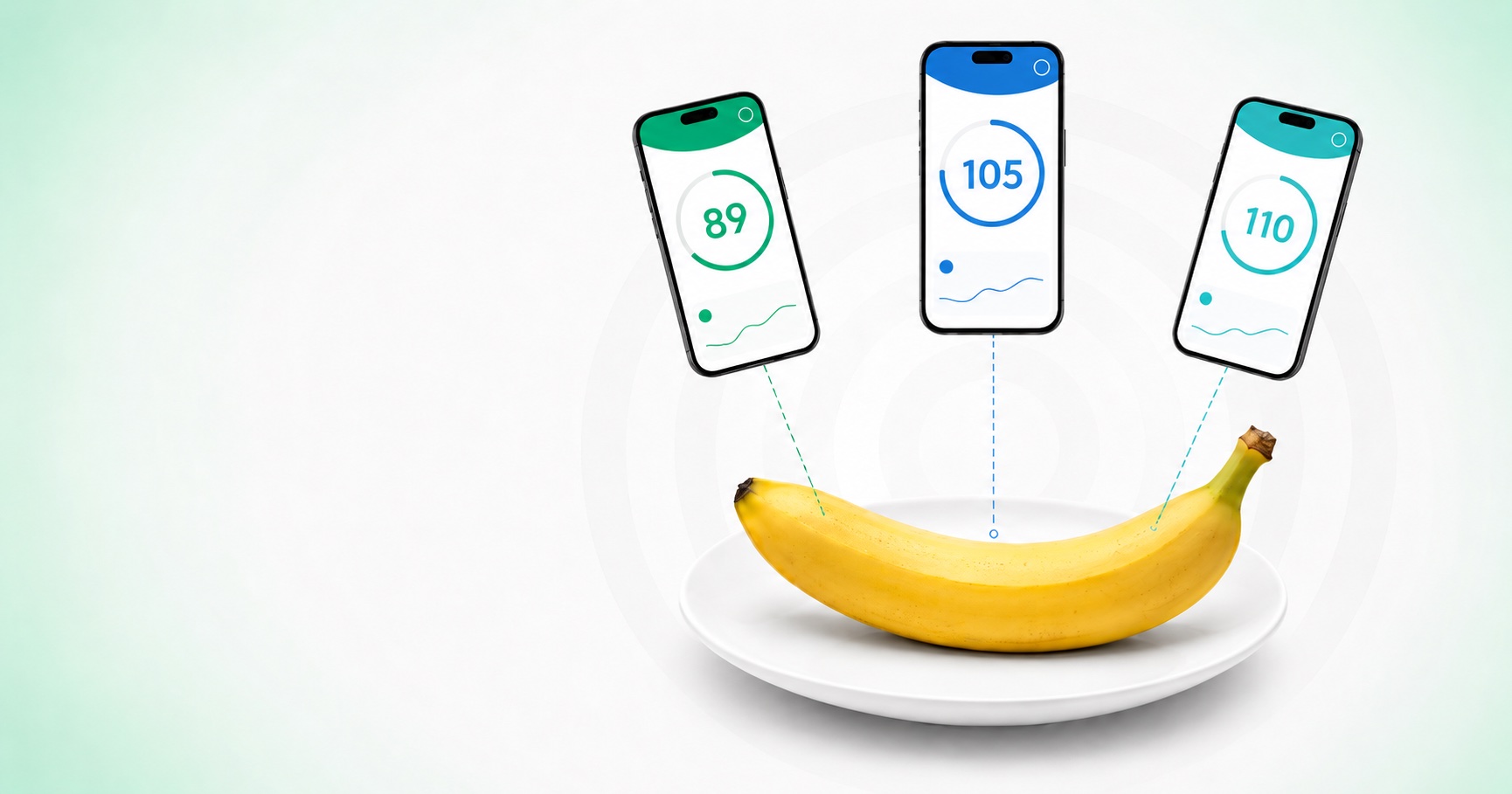
Open three different nutrition apps. Look up "1 medium banana." You'll get:
- 105 calories
- 110 calories
- 89 calories
All three are right.
This drives some people crazy — especially if you grew up on calorie counting and want a single, exact number to track. We see it a lot in support requests: "Your app says my dinner was 612 calories but MyFitnessPal says 587. Which one is correct?"
The honest answer: both are correct, and the question is the wrong one.
This article walks through why calorie estimates inherently vary, what "accuracy" actually means in nutrition, and why "close" is the realistic gold standard — not because we're being lazy, but because the food itself doesn't cooperate with perfectionism.
The Food Itself Is Variable
The calorie number in any database is a statistical average of many measurements. The actual food on your plate is one specific instance.
A real example: chicken breast
USDA's lab tests on chicken breast (boneless, skinless, raw) report 120 calories per 100 grams. But individual breasts in your grocery store cooler range from 104 to 134 calories per 100 grams — a 25% spread, depending on:
- The chicken's age at slaughter (older = slightly more fat)
- The bird's diet (corn-fed vs pasture-raised)
- Where on the breast the meat was cut from (closer to the bone has more connective tissue)
- How much water the processor injected (some are pumped with brine to 15% water by weight)
The 120-calorie number is the average. Your actual chicken breast is somewhere in a wider band around it.
Multiply that across every ingredient
Now picture a recipe with chicken, olive oil, garlic, onions, salt, lemon, and herbs. Each ingredient has its own ±10-20% natural variation. Add them up and the honest calorie number for a single specific dinner is a range, not a point.
Two databases looking at the same recipe can each pick reasonable points in that range and produce numbers that differ by 5-15%. Neither is wrong.
Why Different Databases Pick Different Numbers
There are roughly four big nutrition databases used by consumer apps:
| Database | What it is | Strength | Weakness | |---|---|---|---| | USDA FoodData Central | US government lab measurements | Most authoritative for raw ingredients | Doesn't understand recipes — gives you "raw chicken," you have to do the cooking math yourself | | Edamam | Commercial database + NLP that parses "1 cup diced onion" | Great for whole recipes | More expensive to license, occasional weird picks for ambiguous ingredients | | Nutritionix | Crowd-sourced + restaurant menus | Best for restaurant dishes | Less reliable for home cooking | | MyFitnessPal user database | User-contributed entries | Massive coverage | Many entries are wrong (off by 50%+) — users guess and submit |
When you and your spouse look up the same recipe in two different apps, you're seeing two different databases that each made reasonable interpretations of imprecise underlying data.
A concrete example: "1 medium banana"
- USDA: 89 cal/100g × average banana 118g = 105 calories
- Edamam: parses "medium" as 100g = 89 calories
- MyFitnessPal user entry: someone weighed their banana at 125g = 111 calories
None of these are wrong. They're using different definitions of "medium banana." A real banana on your counter is whatever size it actually is.
What ThisWeekEats Actually Does
We use a four-tier nutrition lookup to get as close to ground truth as possible without pretending precision we don't have:
- Edamam Nutrition Analysis (primary). Their NLP parses "1 cup shredded colby jack cheese" → 445 calories. Best-in-class for recipe-context queries.
- USDA FoodData Central (cross-check). Every Edamam result gets a sanity check against US government lab data. If they disagree by more than 30%, our admin tool flags the recipe for human review.
- Local curated database (fallback). 200+ common ingredients with manually verified values for the cases where Edamam can't parse the ingredient name.
- AI estimate (last resort). For exotic ingredients neither database has. Flagged in the UI so you know it's an estimate.
We deliberately picked Edamam over USDA as primary because Edamam handles the recipe (the whole dish, cooked, with all interactions) while USDA handles the ingredient (a chunk of raw food in a lab). Recipes are what users actually eat.
We also added a cross-check column to our internal audit tool that compares both sources for every recipe. Right now, 98.5% of our recipes agree between Edamam and USDA within a 30% margin. The remaining 1.5% almost always come down to ambiguous ingredient names ("ground pork" — lean or regular? Edamam picks one, USDA picks the other).
What "Accurate Enough" Actually Means
The medical and nutrition research consensus on what counts as "good enough" for everyday calorie tracking:
- ±10% of true value = excellent, essentially indistinguishable from measurement noise
- ±20% = good, fine for weight management and meal planning
- ±30% = acceptable for general awareness, not great for medical-grade tracking (GLP-1 dosing, diabetic carb counting)
- >30% = should be flagged and double-checked
For context, commercial nutrition labels are allowed by FDA to be off by ±20% and still call themselves accurate. That granola bar that says "140 calories" might legally contain anywhere from 112 to 168 calories. Restaurant menus that say "calorie counts are approximate" are usually within ±25-30%.
Our internal target is within ±10% of Edamam's authoritative number, with USDA cross-validation flagging anything outside that range. We hit it on the vast majority of recipes.
When Numbers Differ, Here's What To Do
If you compare two apps and see different calories for the same meal:
- If they're within ±15% of each other, both are right. Don't lose sleep. Pick one app and stick with it for consistency — what matters is your trend over weeks, not any single day's exact number.
- If they differ by more than 30%, one of them probably picked a wrong ingredient interpretation. Open the breakdown and look for the suspicious line item (often "1 cup cheese" where one app picked shredded mozzarella at 80g/cup and the other picked block cheddar at 113g/cup).
- If you're tracking for medical reasons (GLP-1 medications, diabetes management, post-surgery), use the lower estimate as your baseline and add a 10-15% safety margin. Doctors do this anyway.
The Real Goal: Trend, Not Precision
Nutrition science has known for decades that the human body doesn't measure calories with anything like the precision we ask of apps. Two people eating the same 2,000-calorie meal can extract 1,800 or 2,200 absorbable calories depending on their gut microbiome, how cooked the food was, and how well-chewed each bite was.
The calorie number on your screen is a planning estimate, not a thermodynamic measurement of what your body will actually do with the food.
So when we say our calorie counts are "within 10-15% of the gold standard," that's not us hedging — that's a tighter margin than the food itself has. Tighter than the FDA requires of packaged food. Tighter than your body's own absorption variance.
Close is the gold standard. Identical is a myth.
What We're Doing to Get Closer
This isn't an excuse to stop trying. We've shipped multiple rounds of nutrition matcher improvements over the past month, each one chipping the disagreement rate down:
- Edamam-first lookup with USDA cross-validation
- Ingredient canonicalizer that normalizes "chicken breast (boneless, skinless, diced)" → same form Edamam and USDA both interpret correctly
- Smart defaults for ambiguous queries (bare "chicken breast" defaults to boneless/skinless, matching how Edamam parses it)
- Admin audit tool that surfaces the worst Edamam-vs-USDA disagreements first, so we fix them before they hit users
Each fix moves the average recipe a few percent closer to ground truth. None of them will ever achieve "identical."
If you spot a recipe with a number that seems wildly off — say, a chicken salad showing 1,200 calories per serving — please send it to support. Those are bugs and we fix them within a day or two. Everything within ±15% is working as intended.
TL;DR for the Perfectionist in Your Life
- Calorie numbers from any nutrition database are statistical estimates with ±10-20% natural variance, because the food itself varies that much.
- Different databases can pick different (equally valid) interpretations of ambiguous ingredients and still produce trustworthy numbers that differ by 5-15%.
- FDA allows ±20% variance on packaged food labels and that's the legal standard for "accurate."
- ThisWeekEats targets within ±10% of Edamam authoritative numbers, with USDA cross-validation flagging outliers. We hit this on 98.5% of recipes.
- For weight management, meal planning, and everyday tracking, trend over weeks matters infinitely more than any single day's exact number.
- For medical-grade tracking, use the lower estimate plus a 10-15% safety margin — that's what your doctor does anyway.
Close is the gold standard. Pursue it relentlessly. But don't lose sleep when two apps disagree by 12% — that's the food being food.
Ready to Experience AI Meal Planning?
Try ThisWeekEats free for 7 days. No credit card required.
Start Your Free Trial