
What to Eat in Your First Week on Zepbound®
By ThisWeekEats Team
April 26, 2026
8 min read
What to Eat in Your First Week on Zepbound®
Your first injection is in the fridge. You've watched the YouTube tutorials. You're nervous, motivated, and not entirely sure what to expect.
Here's what most prescribing clinicians don't have time to walk you through in the 12-minute appointment: the first 7 days on Zepbound® or Mounjaro® are usually the hardest of your entire treatment. Side effects peak in the first week of any new dose — including the starter dose — and what you eat during that window has more impact on how miserable you feel than at any other point.
This is the practical, registered-dietitian-aligned guide to week one. The food you choose this week determines whether you spend day 4 on the bathroom floor or quietly noticing that your appetite is just... softer.
What's actually going to happen
Tirzepatide (the active drug in both Zepbound® and Mounjaro®) takes effect within hours of your first injection, but the side-effect profile builds over the first 48–96 hours and usually peaks somewhere around day 3–5. The pivotal SURMOUNT-1 trial that earned tirzepatide its obesity indication (Jastreboff et al., N Engl J Med 2022) reported a stepped dose-escalation precisely because higher starting doses produce intolerable GI side effects in many patients. The pooled GI tolerability data we have for the closely-related semaglutide (Wharton et al., Diabetes Obes Metab 2022) is informative and worth knowing: across STEP 1–3, semaglutide 2.4 mg produced nausea in 43.9% of patients, diarrhea in 29.7%, vomiting in 24.5%, and constipation in 24.2%. Most events were mild to moderate and transient. Tirzepatide users typically report similar or higher incidences in the first weeks of a new dose.
The most common first-week experiences are:
- Reduced appetite — usually noticeable within 24 hours
- Mild to moderate nausea, especially in the evening or after meals
- Constipation (very common; starts day 2–4)
- Sulfur burps — the rotten-egg-smelling burps from delayed gastric emptying
- Suppressed thirst — you stop noticing you need water
- Fatigue — partly the medication, partly because you're under-eating without realizing
- Heartburn or reflux in some patients
The good news: the side-effect intensity typically moderates by week 2 or 3 as your body adjusts. The bad news: you have to get through week 1 first, and what you eat (and don't eat) is the single biggest variable you control.
The five rules for week one
Rule 1 — Eat smaller portions, more often
Forget three meals a day. Aim for 5–6 small eating occasions, each roughly the size of a single small bowl. Your stomach is going to fill up faster than you expect, and forcing yourself to eat a full plate is the #1 trigger for nausea and vomiting in the first week.
A reasonable target: eat something every 2.5–3 hours during waking hours, even if it's just a Greek yogurt or a piece of fruit with a hard-boiled egg. The goal is to keep your stomach gently occupied without ever filling it.
Rule 2 — Front-load protein at breakfast
You will probably feel best (least nauseous, most energetic) in the first few hours after waking. Eat real protein at breakfast, even if you don't feel hungry. This single habit prevents the most common week-one disaster: under-eating all day, then trying to "make up" 80 grams of protein at dinner when your stomach can only take 15. There's a biological reason it doesn't work — the dose-response work on muscle protein synthesis (Moore et al., Am J Clin Nutr 2009) showed that ~20 g of high-quality protein at one sitting maximally stimulates MPS in young men; doses higher than that drive amino acid oxidation, not additional muscle synthesis. You cannot front-load all your daily protein into one meal. Spreading it across the day matters more on a GLP-1 than at any other time in your life.
Good week-one breakfasts:
- ¾ cup Greek yogurt + 1 tablespoon chia seeds + ½ cup berries (~22g protein)
- 2 eggs scrambled + 1 oz cheese + 1 slice sourdough (~22g protein)
- 1 scoop whey protein in unsweetened almond milk + ½ banana (~26g protein)
- 1 cup cottage cheese + ½ cup pineapple (~28g protein)
Rule 3 — Avoid the GI triggers
Some foods reliably make week-one side effects much worse. Skip these for at least the first 5–7 days:
- Fried foods (fried chicken, French fries, donuts, anything battered)
- Heavy red meat (especially fatty cuts, sausage, ground beef higher than 85% lean)
- Mature cheeses and heavy dairy (blue cheese, brie, full-fat cream)
- Carbonated drinks (soda, sparkling water, beer)
- Alcohol (delays gastric emptying further; multiplies nausea)
- Spicy or heavily-spiced foods (chili, curry-heavy dishes — wait until your body adjusts)
- Large portions of raw cruciferous vegetables (raw broccoli, raw cauliflower can cause significant gas)
You can return to most of these in week 2 or 3 as your body adjusts. Week one is not the time to test your tolerance.
Rule 4 — Drink water on a schedule
Tirzepatide suppresses thirst, which means by the time you feel thirsty, you're already meaningfully dehydrated. Dehydration in week one will make every other side effect — nausea, constipation, fatigue, headaches — significantly worse.
The simplest fix: drink one full glass of water every time you take a sip of anything else. Coffee → glass of water. Yogurt → glass of water. Walking past the kitchen → glass of water. Aim for 8–10 glasses (64–80 oz) per day.
If plain water isn't appealing, lean on:
- Cucumber water
- Lemon water (warm or cold)
- Herbal tea (peppermint is particularly good for nausea)
- Bone broth (also delivers protein and electrolytes)
- Fruit-infused water with watermelon or berries
Rule 5 — Plan for constipation from day 2
Constipation almost always shows up in the first 48–72 hours and catches people off guard. The fix is multi-pronged and you should start it before you need it:
- Fiber from the start. Oats, chia seeds, ground flaxseed, berries, leafy greens. Aim for 25–30g/day.
- Hydration (see Rule 4)
- Gentle movement. A 20-minute walk in the morning helps gut motility more than people realize.
- Magnesium citrate — talk to your prescribing clinician, but a 200–400 mg dose at bedtime is a common gentle laxative many patients tolerate well.
- Avoid heavy cheese, white bread, and bananas. All three are constipating; not what week one needs.
If you're not having a bowel movement by day 3 and starting to feel uncomfortable, call your clinician. There are gentle prescription options (or OTC ones they'll recommend) that work fast.
A sample week-one day
Here's what a tolerable, protein-floor-meeting, hydration-forward day looks like in week one for a 180-lb adult:
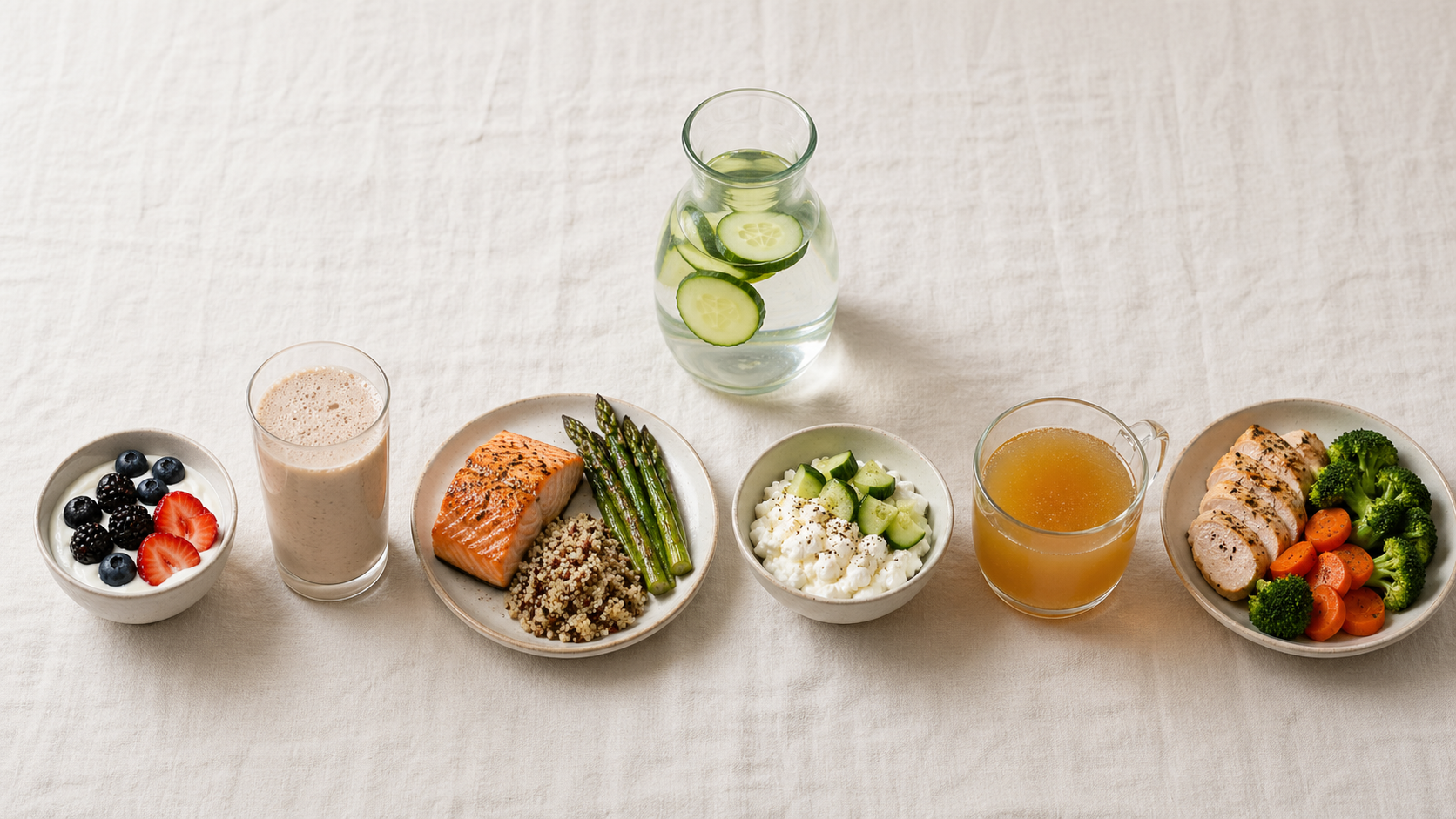
| Time | What | Why | |---|---|---| | 7:00 am | 8 oz water + ¾ cup Greek yogurt + chia + berries | Front-load protein; first hydration | | 9:30 am | 8 oz water + 1 scoop whey in almond milk | Top up protein; second hydration | | 12:30 pm | 8 oz water + 4 oz baked salmon + ½ cup quinoa + steamed asparagus | Largest meal at peak appetite | | 3:00 pm | 8 oz water + ½ cup cottage cheese + cucumber slices | Snack; keeps stomach occupied | | 5:30 pm | 8 oz water + small bowl bone broth | Pre-dinner hydration + electrolytes | | 7:00 pm | Small portion: 3 oz grilled chicken + roasted sweet potato | Light dinner, eat slowly | | Throughout | Peppermint tea, walking 20 min after lunch | Aids digestion, prevents constipation |
Total approximate: 1,300–1,500 kcal, 95g protein, 25g fiber, 80+ oz water.
This isn't a prescription — it's a structural example. Your appetite, dose, and individual tolerance will dictate the exact amounts.
What to keep in the house
Stock your kitchen for week one before your first injection. The last thing you want is to be 36 hours into nausea and trying to figure out what to buy. Have ready:
Refrigerator
- Plain Greek yogurt (large container)
- Cottage cheese
- Pre-cooked or rotisserie chicken
- Frozen salmon fillets
- Eggs
- Berries (fresh or frozen)
- Lemons, cucumbers
- Bone broth (carton or freezer)
Pantry
- Unflavored or vanilla whey/pea protein powder
- Oats (rolled or steel-cut)
- Chia seeds, ground flaxseed
- Quinoa
- Herbal tea (peppermint, ginger)
- Magnesium citrate (talk to clinician)
Freezer
- Frozen broccoli, asparagus, green beans
- Frozen berries (smoothie base)
- Frozen cooked rice or quinoa portions
That's enough infrastructure to coast through a bad week without ordering takeout that will trigger nausea.
Red flags — when to call your clinician
Most week-one side effects are uncomfortable but expected. Call your prescribing clinician immediately if you experience:
- Severe abdominal pain that doesn't go away with rest (could indicate pancreatitis, a known but rare GLP-1 risk)
- Vomiting that prevents you from keeping water down for more than 12 hours (dehydration risk)
- Severe headache, confusion, or rapid heartbeat (electrolyte imbalance)
- No urination for 12+ hours (dehydration)
- Yellowing of skin or eyes (gallbladder concern, also a known GLP-1 risk)
Don't wait to see if it gets better. These are uncommon but real, and your clinician would rather you call.
Where ThisWeekEats™ fits in week one
Week one is exactly the time you don't want to be making decisions about food. ThisWeekEats™ plans the week around the rules above — small portions, protein floor, GI-trigger avoidance, hydration-forward foods, fiber for constipation. You hit Generate, the week appears, the shopping list is ready, and you can focus on getting through the side effects rather than figuring out what to put in your cart.
The bottom line
- Side effects peak in week one. What you eat matters more this week than at any other point.
- 5–6 small meals, not 3 big ones. Your stomach can't handle big plates yet.
- Protein floor at breakfast. Don't try to "make up" protein at dinner.
- Avoid fried, fatty, carbonated, and alcohol for at least the first 5–7 days.
- Drink water on a schedule — 8–10 glasses per day, not based on thirst.
- Plan for constipation from day 2 — fiber, hydration, movement, possibly magnesium.
- Stock your kitchen before your first injection. Don't try to grocery-shop while nauseous.
- Call your clinician for severe abdominal pain, persistent vomiting, no urination, or signs of dehydration.
Week one is the steepest learning curve. Get through it well and the rest of your treatment is dramatically easier.
Ready for a plan that handles week one for you?
ThisWeekEats™ generates a week of small, gentle, protein-anchored meals built around exactly the rules in this article.
Peer-reviewed sources cited in this article
- Jastreboff AM, Aronne LJ, Ahmad NN, et al. Tirzepatide Once Weekly for the Treatment of Obesity (SURMOUNT-1). N Engl J Med. 2022;387(3):205-216. DOI: 10.1056/NEJMoa2206038
- Wharton S, Calanna S, Davies M, et al. Gastrointestinal tolerability of once-weekly semaglutide 2.4 mg in adults with overweight or obesity. Diabetes Obes Metab. 2022;24(1):94-105. DOI: 10.1111/dom.14551
- Moore DR, Robinson MJ, Fry JL, et al. Ingested protein dose response of muscle and albumin protein synthesis after resistance exercise in young men. Am J Clin Nutr. 2009;89(1):161-168. DOI: 10.3945/ajcn.2008.26401
- Mozaffarian D, Agarwal M, Aggarwal M, et al. Nutritional priorities to support GLP-1 therapy for obesity: A joint Advisory from the ACLM, ASN, OMA, and The Obesity Society. Obesity (Silver Spring). 2025;33(8):1475-1503. DOI: 10.1002/oby.24336
Important medical & trademark disclaimer
This article cites peer-reviewed primary sources and consensus advisories from major nutrition and obesity-medicine societies. It is general nutrition information, not medical advice, and does not create a provider-patient relationship. Individual reactions to a GLP-1 medication vary widely; the dose, schedule, and personal nutrition targets must come from your prescribing clinician and a registered dietitian. Always consult them before making dietary changes.
ThisWeekEats™ is not affiliated with, endorsed by, or sponsored by Eli Lilly, Novo Nordisk, or the makers of any GLP-1 receptor agonist medication. Zepbound® and Mounjaro® are registered trademarks of Eli Lilly. Ozempic® and Wegovy® are registered trademarks of Novo Nordisk. These names are used here solely to identify the medications our readers may be taking.
Ready to Experience AI Meal Planning?
Try ThisWeekEats free for 7 days. No credit card required.
Start Your Free Trial